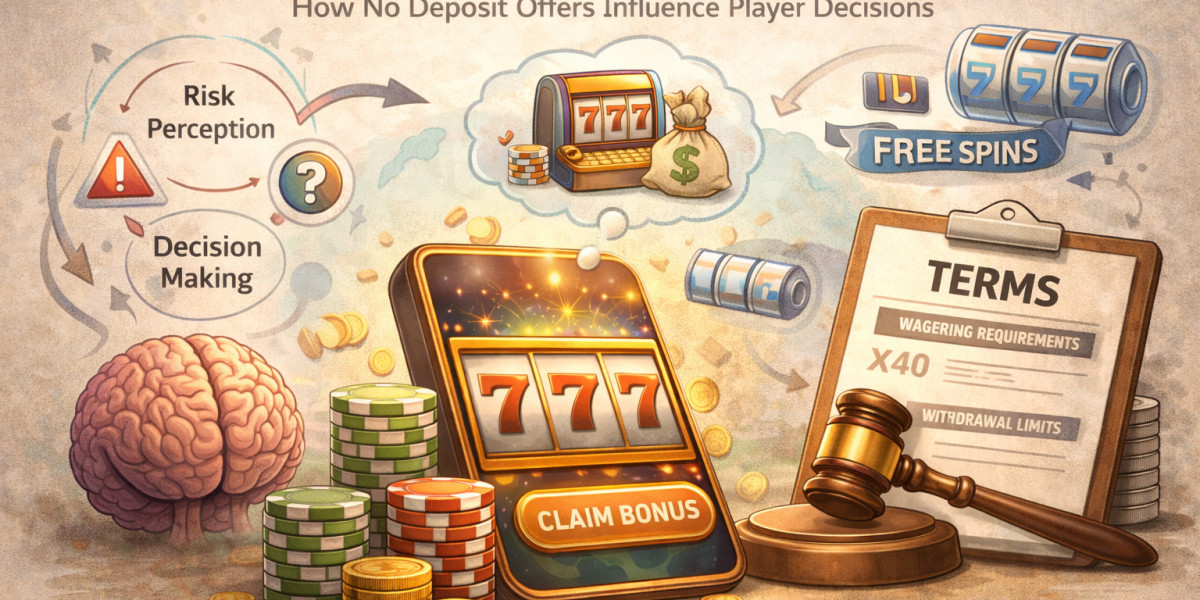

Online casino bonuses are not simply marketing incentives. They are carefully structured behavioral tools designed to influence how players perceive risk, value rewards, and make decisions under uncertainty. From deposit matches to free spins and especially no deposit bonuses, each format leverages specific psychological mechanisms rooted in behavioral economics. Understanding these mechanisms reveals why such offers are so effective at driving engagement and shaping long term player behavior.
At the core of no deposit bonuses lies the zero price effect. Behavioral research shows that when something is offered for free, people tend to overvalue it and underestimate associated conditions. A no deposit offer removes the immediate financial barrier, creating the impression that participation carries no downside. Even when wagering requirements are substantial, the absence of an upfront payment changes the perceived risk profile. The player does not feel like they are making a financial decision but rather accepting an opportunity.
This shift in perception directly affects decision making. When no money is initially invested, players are more willing to explore, experiment, and take risks they might otherwise avoid. The cognitive framing changes from loss avoidance to opportunity maximization. The possibility of winning real money from bonus funds activates reward anticipation without triggering the same level of financial caution that accompanies personal deposits.
Free spins operate in a similar way but add another behavioral layer. By restricting the bonus to specific slot games, operators channel player attention toward high engagement products. The structure of slot games, based on variable reward schedules, enhances anticipation and emotional intensity. Free spins allow players to experience these mechanics without feeling immediate financial exposure. However, once small wins accumulate, the sense of ownership emerges. Behavioral economics refers to this as the endowment effect. Players begin to treat bonus winnings as their own funds, even though they originated from promotional credits.
Wagering requirements play a subtle but powerful role in sustaining engagement. A bonus that requires a thirty or forty times playthrough transforms what might have been a short session into a prolonged activity. The sunk cost fallacy becomes relevant here. Once players invest time and effort toward clearing wagering conditions, quitting feels like wasting progress. Even if the mathematical expectation is negative, the psychological commitment increases the likelihood of continued play.
Time limits further intensify the effect. Many no deposit offers are valid for a limited number of hours or days. Scarcity triggers urgency. Behavioral economics consistently demonstrates that individuals are more motivated to avoid losing an opportunity than to pursue a comparable gain. When a countdown is attached to a bonus, players are nudged toward faster decisions and more frequent play sessions. Rational evaluation of expected value is often replaced by emotional responsiveness to perceived scarcity.
Another important factor is loss aversion. Once bonus funds are credited, potential losses feel real, even though no personal deposit was made. If a player builds a balance from free spins and then sees it decline, the emotional reaction resembles that of losing personal money. This reaction often motivates further play in an attempt to recover or protect perceived gains. In this way, an initially risk free offer gradually transitions into risk taking behavior.
Different bonus structures influence different decision patterns. Deposit match bonuses typically encourage higher initial deposits because players anchor their decision around maximizing the bonus percentage. Cashback offers reduce perceived downside risk and may increase session duration. No deposit bonuses are particularly powerful at attracting new users because they eliminate entry friction entirely. Each type reflects a different behavioral lever, whether it is anchoring, risk framing, or reward anticipation.
Tables that compare multiple no deposit offers often reveal how operators vary wagering multipliers, maximum withdrawal caps, and eligible games. These parameters are not arbitrary. A lower maximum withdrawal limit reduces operator exposure while still preserving the illusion of meaningful upside. High wagering requirements extend engagement. Game restrictions guide player activity toward titles with specific return to player percentages. Each condition subtly shapes how the player interacts with the platform.
From a behavioral economics perspective, casino bonuses function as choice architecture. They do not force decisions, but they design the environment in which decisions are made. By adjusting how risk and reward are framed, operators influence perception without altering the underlying probabilities of the games themselves. The players subjective experience of value often diverges from the objective expected value.
Understanding these dynamics is essential for informed participation. Bonuses can provide entertainment and extended playtime, but they are structured around predictable cognitive biases. The zero price effect, endowment effect, sunk cost fallacy, scarcity bias, and loss aversion all contribute to why no deposit offers and free spins are so compelling. Recognizing these behavioral patterns allows players to evaluate promotions more critically and make decisions based on awareness rather than impulse.