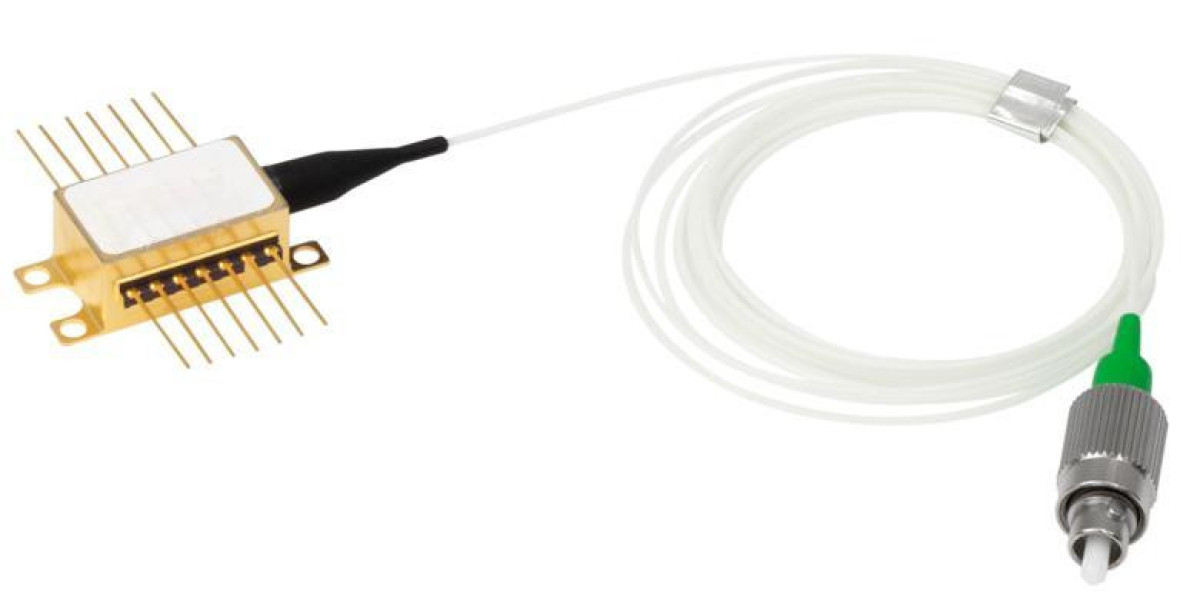

In modern optical communication and photonic signal transport systems, the choice of laser diode architecture matters deeply. Among the options, DML Laser and microwave DFB laser stand out for their reliability, bandwidth, and applicability in RF-over-fiber, telemetry, and high-speed data links.
A DML Laser — more fully, a directly-modulated laser — simply means the modulation signal is applied directly to the injection current of the laser diode. In this scheme, the output optical power varies in sync with the electrical drive signal, enabling relatively straightforward modulation and compact module design. The family of lasers described by NEON under “High-Speed DFB DML Laser Series” uses this direct modulation approach.
On the other hand, a microwave DFB laser is a subtype of DFB (distributed feedback) laser optimized to transmit high-frequency RF signals over fiber. The “microwave” attribute refers to its support for very wide bandwidth — often up to 12 GHz or even 18 GHz according to the module specification. This enables the direct carriage of RF signals (for example, in antenna remoting, telemetry, reference signal distribution, or delay line applications) without first converting them to digital data.
What makes such lasers useful is their combination of stable single-wavelength operation (due to the DFB grating structure) and the ability to modulate directly with RF signals. Because the grating provides feedback and wavelength selectivity across the cavity (instead of simple end-mirror reflection), the laser maintains high spectral purity, stable wavelength, and low noise — essential traits for high-fidelity RF-over-fiber links or time/frequency distribution systems. (As general background, DFB lasers have been described as having periodic refractive index gratings within their active region to realize stable single-frequency output.) NEON’s modules — including series such as NY13D Series, NY15D Series, and NYCMD Series — are representative of such microwave DFB lasers. For instance, the NY13D series is described as a “1310nm Microwave DFB Laser Module” optimized for linear fiber-optic communications with wide bandwidth.
In summary: DML Laser and microwave DFB laser are foundational building blocks of modern photonic and RF-over-fiber systems. The former emphasizes modulation simplicity and cost-efficiency; the latter delivers high-bandwidth, stable, narrow-linewidth performance ideal for RF distribution, telemetry, or analog signal transmission over optical fiber. For anyone designing or evaluating fiber-optic RF links, radar signal transport, or distributed antenna systems, understanding these laser types is essential.